
Exercises for tennis elbow

Learn exercises to help with tennis elbow
after any elbow problem, it’s important to get movement and strength back. This supports tissue healing and will help you get moving again. You may not be able to return to your usual exercise levels immediately and improvements may be slow to start with.
 However, a gradual return to normal activities is the best way to get good short and long term results after a back problem. When doing exercise you should listen to your pain levels, especially in the early stages. You may find that these exercises increase your symptoms slightly in the beginning.
Rest is the best treatment for tennis elbow. It usually heals on its own if you can stop the constant movements that caused it. Here are other nonsurgical ways to treat tennis elbow: ice: experts recommend icing for 15 minutes every 3 to 4 hours to reduce pain and swelling. Mulligan mobilisation with movement and taping: this is a form of physical therapy that repositions the muscles to protect the injured tendons from further strain. Physical therapy: a professional can show you exercises to strengthen and stretch the muscles in your shoulder, upper arm, and wrists. Steroids: shots into your elbow tendons can briefly ease some of the swelling and pain around your elbow joint. https://webmed.com
How to tell if you’re exercising at the right level
Make sure to consult your gp before exercising any area of the body. Do know that physiotherapy exercises can go a long way toward bringing the affected area back to its previous level of strength.
Elbow flex and extend
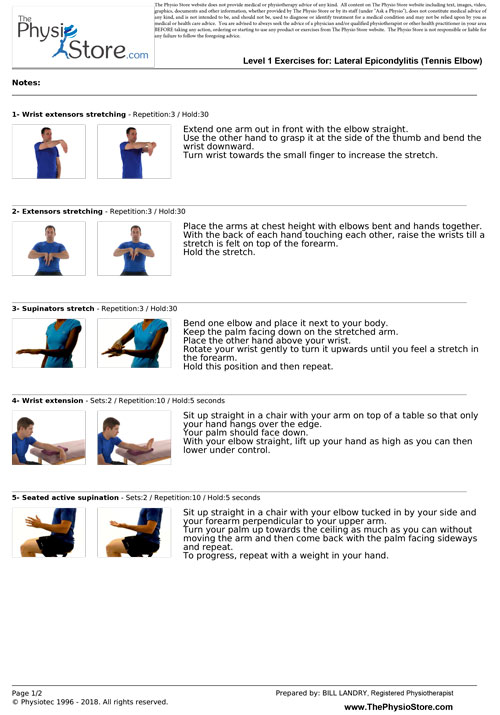
This exercise provides you with a stretch from your elbow to your wrist. Stretch the affected arm straight out in front of you. Turn it over so your hand is facing up. Using your other hand, gently push the extended hand toward the floor, pulling backward. Only bend at the wrist so the rest of your arm remains straight. Hold the stretch for 15 to 30 seconds and release. Repeat two to four times. Repeat the exercise on your other hand if needed. The wrist extensor is essentially the wrist flexor flipped over. Stretch the affected arm straight out in front of you, but this time keep your forearm and palm facing down.,p>
The second exercise for tennis elbow that we recommend is an eccentric forearm strengthening exercise. In order to complete this exercise, obtain a small dumbbell, approximately 1 – 1. 5kg and hold it in the hand. Place a small, rolled up towel underneath the wrist and allow your hand to hang over the desk in a neutral position. Gently lower the hand, whilst holding the dumbbell until your wrist cannot flex any further. Then, with your other hand, grab the entire hand and dumbbell and lift it up into the maximum extended position. It is really important that as you transition from the fully flexed position to the fully extended position, you do not use the muscles in your sore arm to help lift it up.
Always stretch before you do strengthening exercises. As you get stronger, your healthcare provider may tell you to you add weights or more repetitions to your strengthening exercises. He or she will tell you how much weight to use. Wrist curls: hold your arm out in front of you. Turn your palm so that it faces up and hold a weight in your hand. Ask your healthcare provider how much weight you should use. Slowly bend and straighten your wrist 30 times. Bicep curls: place your hand under your injured elbow for support. Turn your palm so that it faces up and hold a weight in your hand.
It's best to do a variety of elbow exercises for pain to experience their effect. Still, it would be best if you avoided tennis elbow exercises and stretches that make you uncomfortable or worsen the situation. Strengthening exercises include some of the moves with the weighted wrist extension, weighted wrist flexion, weighted wrist rotation, and ball squeezes and towel twists. Exercises when you stretch the wrist extensors and flexors also can improve the flexibility of all the affected muscle groups.